
Menu
Doral Commercial Concrete: Permits & Inspections
Commercial Concrete Doral
To understand the rules of how you can complete commercial concrete projects in Doral, you have to know the local Doral Building Codes and how the city’s building department processes permits and inspections, as well as the way they work with Miami-Dade County to enforce the Florida Building Code that provides for the structural integrity of buildings and the safety of the public. In order to begin any type of commercial concrete construction (i.e., foundation work; structural walls; slabs, etc.), a contractor has to obtain the necessary permits from the City of Doral Building Department before commencing any such work. By being aware of these permitting requirements, you will be able to avoid costly delays and be assured that your project complies with all relevant laws and regulations. To complete your project, it would be advisable to coordinate early with the building officials and prepare all necessary documentation.
Commercial Concrete Permits in Doral
Commercial concrete projects in Doral must obtain a building permit from the City of Doral Building Department, which is located at 8401 NW 53rd Terrace. This permit application process will require a detailed set of construction drawings to be electronically signed and sealed by licensed design professionals, and must include structural calculations and material specifications. In most cases, this will be a multi-disciplinary effort, which could include building, structural, and potentially electrical and plumbing permits, depending on the project scope.
In order to obtain permits, contractors must first register with the City of Doral Building Department. They must also continue their registration throughout the entire project period. Additionally, the Miami-Dade County Municipal Permit Applications and Contact Forms must be completed for all new construction and commercial projects. Doral offers an early-start permitting option, which provides a faster plan review for qualified projects, allowing contractors to start working sooner while still maintaining the necessary safety standards.
Required Documents and Drawings
Construction documents for commercial concrete work must indicate the compressive strength of the concrete, the type of reinforcement used, and dimensional tolerances as per the American Concrete Institute (ACI) 318 and the Florida Building Code (FBC). The drawings must show the location of the reinforcing steel, lap splices, and anchorage length for all structural components. Post-tensioning specifications require special attention regarding the amount of force applied to the tendons and the minimum compressive strength of the concrete at the time of tensioning.
Engineered drawings are typically required for any structure larger than standard sizes, and/or any structural element where load paths are being affected. The structural engineer must provide documentation showing how the building meets the FBC wind-load requirements, seismic design criteria, and special inspection protocols. The documentation must also show how the dimensions of the structural members will change due to creep, shrinkage, and thermal expansion-contraction effects that affect long-term structural performance.
Compliance with the Florida Building Code
Chapter 19 of the Florida Building Code governs the use of concrete construction materials, quality control, design, and construction methods for all commercial concrete projects in Doral. Structural concrete must meet the ACI 318 standards as modified by the State of Florida to reflect regional climate conditions. For example, high humidity, salt air, and high winds are typical conditions in South Florida that affect the design and performance of structural concrete.
Commercial concrete must meet exposure classification requirements based on environmental conditions, including freeze-thaw resistance and chloride exposure protection. Air-entrained concrete is always required for exterior applications where moisture and temperature cycling will occur during construction and service life. Some special provisions apply to structures in seismic design categories A and B, and structures in coastal areas that require enhanced durability.
Concrete Materials and Testing Requirements
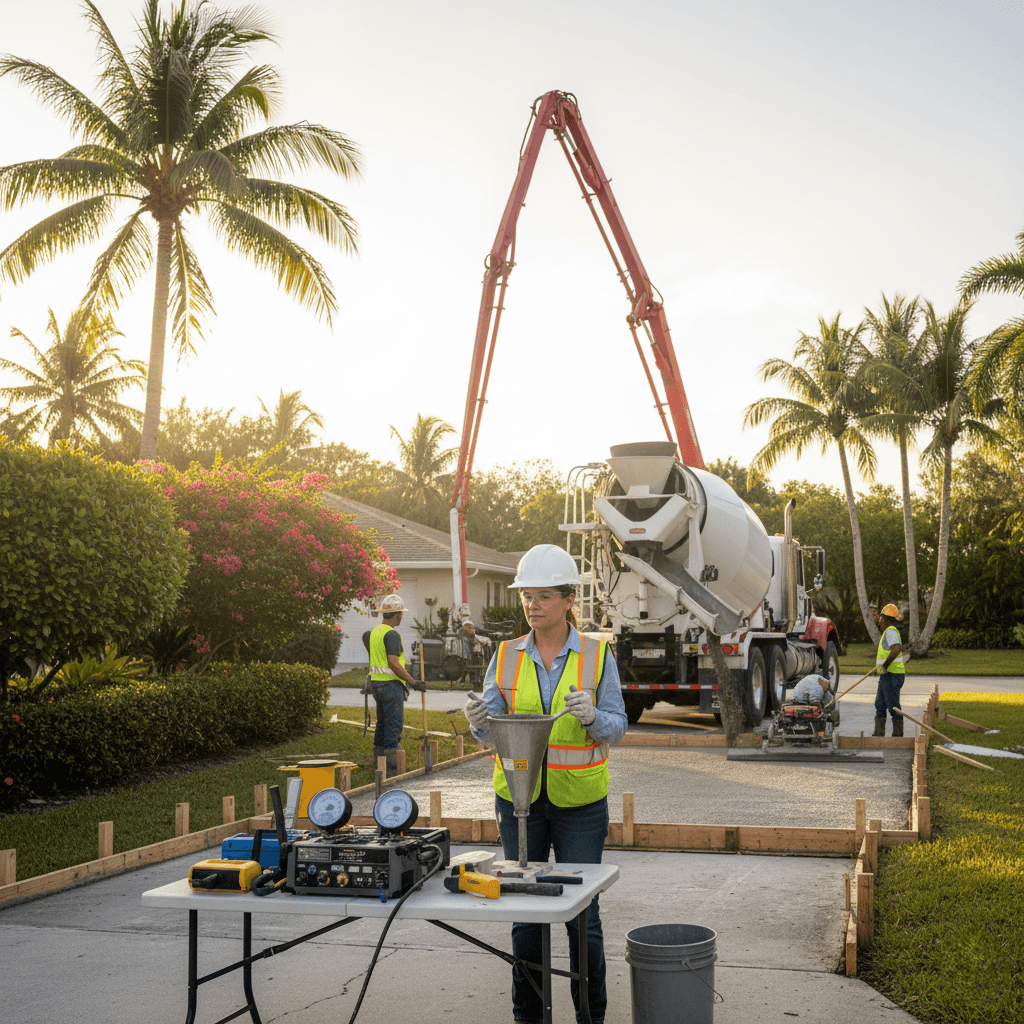
Concrete materials and testing must meet the applicable ASTM standards referenced in ACI 318 and approved by the Miami-Dade County product approval systems. Ready-mixed concrete suppliers must provide certified mix designs that meet the specified compressive strength and durability requirements. Quality control testing includes compression tests of cylindrical specimens at 7, 14, and 28 days.
Reinforcement steel must meet grade specifications, have the proper mill test certificate, and meet ASTM standards. Welded wire reinforcement, post-tensioning systems, and specialized anchoring products must receive Miami-Dade County Notice of Acceptance approval before their installation. Many projects located near cultural landmarks such as the Doral Contemporary Art Museum require enhanced material specifications to achieve aesthetic and durability goals.
Inspection Schedules and Coordination
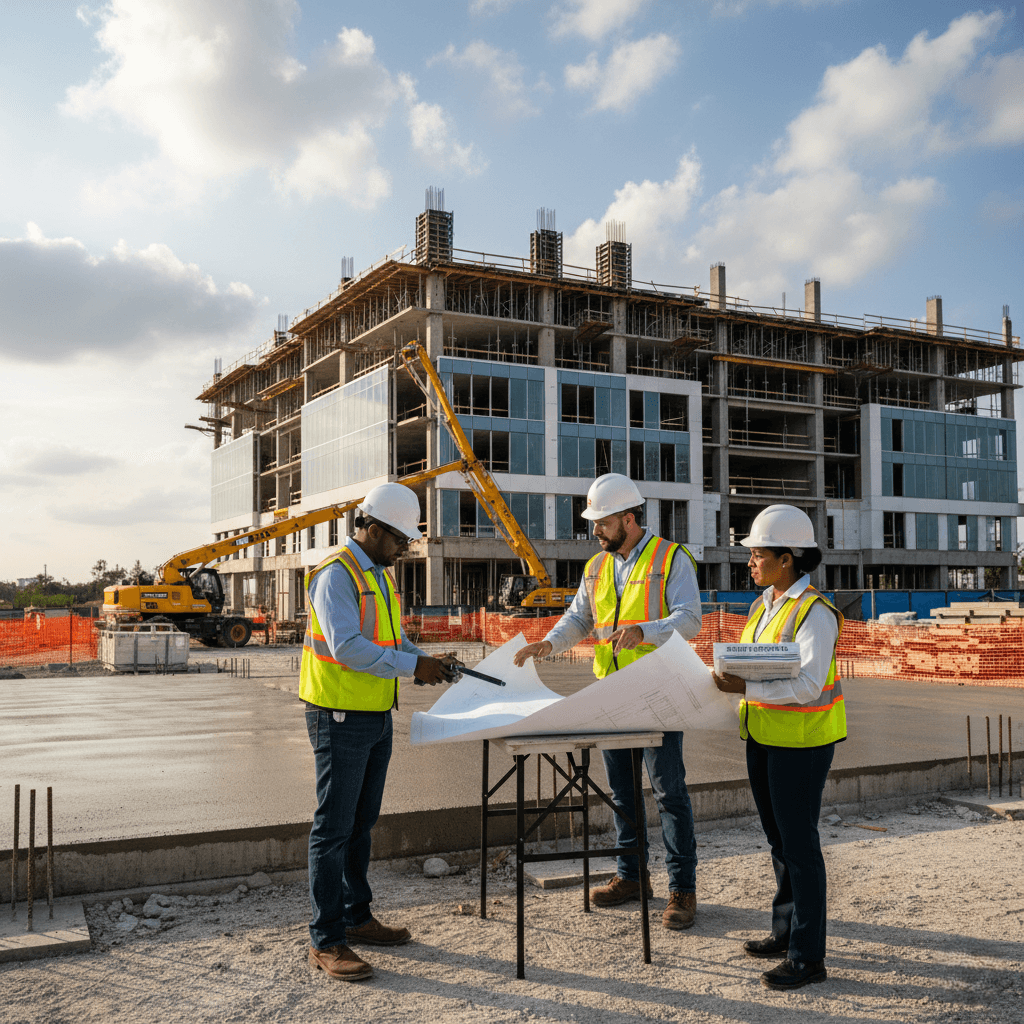
Multiple inspections must be scheduled and coordinated with Miami-Dade County Building Department inspectors during the construction phase of commercial concrete construction. The foundation inspections verify that the excavation was done properly, the reinforcement was placed correctly, and the forms were constructed correctly before placing the concrete. Structural inspections are conducted during the placement of the reinforcement, before placing the concrete, and at completion of the project to verify that the structure complies with the approved plans and specifications.
Contractors must make arrangements for inspections at least one business day in advance, either through the online permitting system or by contacting the inspection department by telephone. Virtual inspections are available for certain applications using WhatsApp or Microsoft Teams applications for remote verification. If the inspections fail, the contractor must correct the deficiencies and resubmit the structure for inspection before proceeding to the next phase of the project.
Special Inspection Requirements
Structures that exceed threshold building limits and require special inspections must hire qualified special inspectors in conjunction with the routine building department inspections. The special inspectors continuously or periodically observe the critical construction elements of the structure, such as high-strength concrete, post-tensioning operations, and structural steel connections. The special inspectors will report to the Miami-Dade County Building Official upon completion of the special inspections.
Specialized inspection reports are required for lightweight insulating concrete installations to demonstrate compliance with the Florida Building Code, product approval notices, and manufacturer specifications. The Miami-Dade County Building Official must be notified before conducting the final inspections of specialized concrete systems. Due to the proximity of many projects to MAU Park and other institutional developments, many special inspection protocols have been increased.
Contractor Registration and Licensing
All contractors performing commercial concrete work in Doral must remain registered with the City of Doral Building Department and appropriately licensed through the Florida Department of Business and Professional Regulation. To demonstrate competence, all concrete contractors must pass an examination and provide evidence of insurance, bonding, and workers’ compensation coverage before receiving registration approval.
Subcontractors that perform specialized work such as post-tensioning, precast installation, and decorative concrete applications must possess the necessary trade licenses and must also remain registered. All professional engineers and architects who provide design services must possess valid Florida professional licenses that are up-to-date with respect to continuing education requirements. Audits are performed regularly to determine if contractors are complying with the licensing and registration standards.
Insurance and Bonding Requirements
Commercial concrete contractors must carry general liability insurance with minimum policy limits established by local ordinances and project requirements. Performance bonds may be required for public works projects or for large private developments based on the contract value and complexity of the project. Workers’ compensation insurance is mandatory for all contractors that employ employees on the job site.
Professional liability insurance is required for all design professionals providing structural engineering and architectural services for commercial concrete construction projects. The bonding requirements will depend on the size and complexity of the project and whether it is a public or private sector project. Public sector projects and projects adjacent to public facilities typically require higher bonding amounts.
Plan Review Process and Timeline
The City of Doral Building Department performs a complete review of all commercial concrete construction plans to assess structural integrity, code compliance, and coordination with other building systems. The review time frame varies based on the level of complexity of the project, completeness of the submittals, and current workload of the department. Typical reviews take 10 to 15 business days to complete; however, complex projects may require additional time to coordinate with specialty consultants.
Expedited review options are available for projects that meet specific criteria, such as green building certifications, and projects over $50,000. Private provider options allow qualified design professionals to perform plan reviews and inspections under approved quality assurance programs to potentially reduce review timelines while maintaining safety standards. Communication with plan review staff facilitates the identification and resolution of issues prior to submission of the project for approval.
Typical Plan Review Comments and Solutions
Frequent plan review comments concern the detailing of reinforcement, requirements for concrete cover, and detailing of connections that meet wind-load and seismic design requirements. Careful detailing of drainage and waterproofing for foundations and below-grade structures is critical in South Florida’s high water table conditions. Complying with accessibility requirements concerning slope, texture, and dimension for commercial applications is essential.
Designers must also consider environmental factors, such as designing proper drainage systems, designing stormwater management systems, and complying with the Department of Environmental Resources Management requirements for projects that impact wetlands or water features. Coordinating with the fire department access requirements, locating utilities, and preserving landscaping ordinances will help prevent conflicts during construction. Proactively coordinating design efforts to avoid these issues will minimize review cycles.
Permit Fees and Payment Methods
Permit fees for commercial concrete work are determined by construction value, square-foot area, and specific permit types as defined in the City of Doral Building Department fee schedule. The base permit fees include the cost of plan review, inspections for multiple trades, and related sub-permits that are submitted concurrently with the primary permit application. Additional fees are charged for expedited reviews, after-hour inspections, and specialty services.
Some commercial developments may be subject to impact fees for schools, roadways, and fire services based on the occupancy classification and square footage of the project. Payment methods include online processing through the e-permitting system, in-person payment at the building department, and certified funds for larger permit applications. The fee calculation takes into consideration the complexity of the project and coordination requirements with multiple reviewing authorities.
Regulatory Costs and Budgeting
Regulatory costs for commercial concrete projects consist of permit fees, inspection fees, plan review fees, and potential third-party testing fees. Special inspection fees are dependent upon the duration of the project and frequency of inspections. Professional services for engineering, surveying, and specialty consultants increase total regulatory costs and must be included in the project budget planning phase.
Value engineering during design phases can optimize permit costs by eliminating excessive complexity while maintaining structural performance and safety standards. Understanding permit fees will enable contractors to provide accurate cost estimates to owners and ensure sufficient funding for all regulatory requirements. Projects located in emerging areas of Doral may qualify for economic development incentives to offset some regulatory costs.
Doral Concrete Works provides comprehensive assistance to navigate the complex regulatory environment associated with commercial concrete construction in Doral. Our experienced team knows current building codes, permit processes, and inspection requirements to facilitate the smooth progress of your project from conceptualization through final approval. We coordinate with building department personnel, special inspectors, and design professionals to minimize delays and ensure full compliance with all relevant regulations. Regardless of whether you are constructing foundations, structural components, or specialized concrete systems, our knowledge of local regulatory requirements ensures the successful completion of your project that achieves both functional and fiscal goals and maintains the highest quality and safety standards throughout the commercial concrete construction process.
LATEST POSTS